
Waterproof Battery Systems Enhancing Electric Motorcycle Safety
Integrating heavy-duty waterproof battery systems enhancing personal two-wheeled transit safety represents a fundamental engineering milestone that protects high-voltage electrical architectures from catastrophic environmental degradation.
Unlike legacy internal combustion powertrains that merely require guarded air intakes, zero-emission motorcycles carry sensitive, dense lithium-ion arrays operating at substantial voltages.
Allowing liquid ingress into these centralized energy storage reservoirs causes immediate electrical short circuits, accelerated galvanic corrosion, and potentially uncontrollable thermal runaway events.
Consequently, modern motorcycle designers invest immense resources into developing hermetically sealed enclosures capable of withstanding severe highway rainstorms, deep flash flood puddles, and high-pressure washing maintenance.
What are IP67 and IP69K ratings and how do they define battery safety?
International Electrotechnical Commission ingress protection codes provide consumers and fleet mechanics with standardized, empirical metrics regarding an enclosure’s resistance to environmental particle and liquid penetration.
The first digit evaluates solid particulate defense, whereas the second digit measures operational survivability against varying volumes, angles, and pressures of liquid water.
An IP67 rating signifies that a vehicle’s primary battery pack survives total liquid immersion up to one meter deep for exactly thirty continuous minutes without suffering structural breach.
Conversely, the ultra-rigorous IP69K standard demands that internal seals repel high-pressure, superheated steam jets directed at the chassis from multiple sharp angles.
Recognizing these manufacturing benchmarks confirms that selecting waterproof battery systems enhancing structural vehicle resilience shields riders from unpredictable weather conditions across changing urban commuting landscapes.
Certified enclosures guarantee that internal electronics remain entirely dry, preserving system insulation resistance values even when roads turn into temporary rivers.
How do breathable ventilation membranes prevent internal condensation buildup?
Maintaining a fully sealed, waterproof environment creates an engineering paradox regarding changing internal temperatures and resultant atmospheric pressure differentials within the battery pack.
As lithium-ion cells discharge energy rapidly during highway acceleration phases, they generate heat, causing internal air volume to expand and press outward against structural rubber gaskets.
When the bike parks in a cold downpour, the sudden external temperature drop creates a vacuum effect that tries to suck external moisture past structural joining seams.
To mitigate this destructive stress, engineers integrate specialized polytetrafluoroethylene ventilation patches that allow gas molecules to pass freely while blocking larger liquid water droplets entirely.
To review official consumer motor vehicle safety recalls, analyze comprehensive clean transportation safety regulations, and verify highway compliance standards for personal electric transportation devices, the U.S. National Highway Traffic Safety Administration (nhtsa.gov) provides open access to public archives.
| Ingress Rating Standard | Liquid Protection Layer | Pressure Resistance Limit | Minimum Test Duration | Primary Hardware Application |
| IP65 Certification | Low-pressure water jets | 30 kPa at 3 meters distance | 3 continuous minutes | Auxiliary dashboard displays |
| IP66 Certification | High-pressure heavy streams | 100 kPa at 3 meters distance | 3 continuous minutes | External wire harness couplers |
| IP67 Certification | Temporary liquid submersion | 1 meter static water depth | 30 continuous minutes | Core powertrain battery packs |
| IP69K Certification | High-temperature steam jets | 10,000 kPa at 80°C temperature | 30 seconds per position | Heavy industrial utility bikes |
Why does galvanic corrosion present a hidden threat to high-voltage wiring?
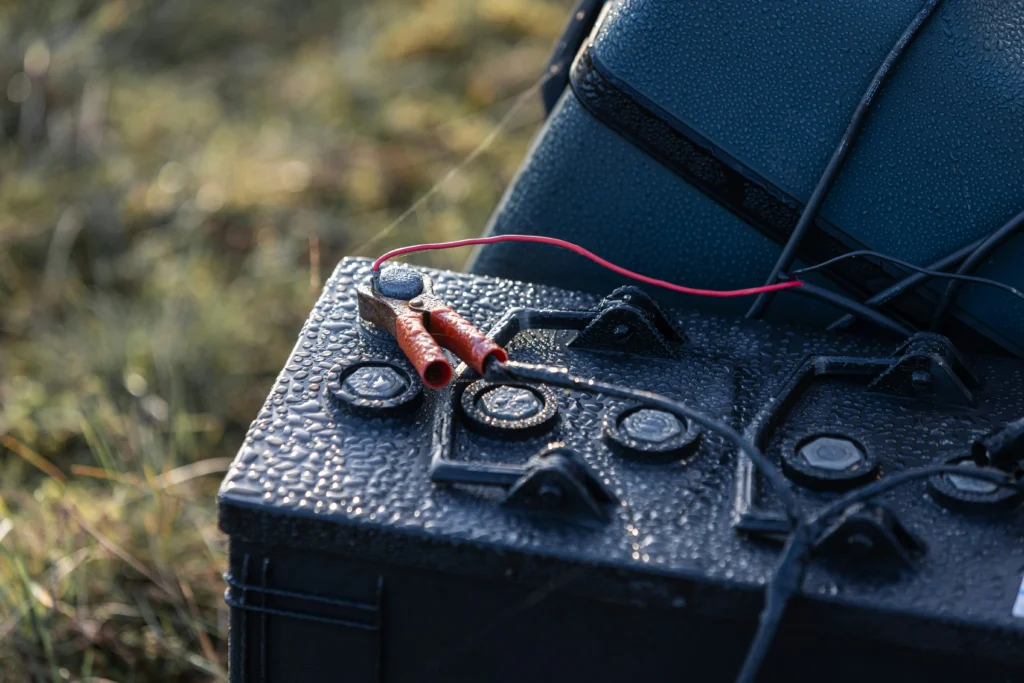
Allowing even microscopic amounts of moisture to penetrate an electric motorcycle’s internal chassis initiates an insidious chemical degradation process known as galvanic corrosion.
When moisture bridges the physical gap between dissimilar metals under an active electrical current, it accelerates the breakdown of critical copper terminal connections.
Learn more: How E-Scooter Fleets Use Swappable Batteries to Reduce Logistics Costs
This localized degradation increases electrical resistance across high-voltage busbars, generating dangerous hot spots that degrade neighboring cell wrappers over months of operation.
Eventually, the compromised connections cause erratic power delivery profiles, unexpected diagnostic error codes, or complete vehicle shutdown events mid-ride.
Investing in waterproof battery systems enhancing total vehicle lifecycles eliminates this hidden structural threat entirely, keeping high-voltage contact surfaces pristinely dry throughout multi-year ownership periods.
Preventing internal oxidation ensures that electrical current travels efficiently, maintaining predictable range metrics and snappy throttle responses over thousands of charging cycles.
Which material innovations reinforce battery enclosures against mechanical impacts?
Constructing a highly resilient waterproof enclosure requires specialized materials that survive intense road vibrations and gravel impacts without cracking or expanding unevenly over time.
High-grade cast aluminum alloys are frequently selected because they offer superior structural rigidity alongside excellent thermal dissipation properties for internal cell matrices.
Read more: Electric Motorcycle Charging Station Compatibility Issues
Furthermore, advanced liquid silicone gaskets are injected directly into precision-machined sealing grooves, ensuring uniform compression across the entire structural mating surface of the battery chassis.
These flexible elastomer compounds retain their tight sealing properties across extreme temperature swings, preventing degradation from intense winter cold or summer heat.
To explore extensive data regarding renewable infrastructure developments, analyze comprehensive technical studies on advanced battery chemistries, and read verified scientific reports on clean transit initiatives, the National Renewable Energy Laboratory (nrel.gov) serves as an authoritative repository for sustainable energy innovation.
Securing a reliable future for clean transportation through robust engineering
The rapid optimization of ingress protection technologies represents a vital victory for consumer safety, product reliability, and the widespread adoption of clean transit solutions worldwide.
Moving beyond fragile prototypes allows modern electric motorcycles to conquer challenging global environments with the exact same rugged dependability as legacy internal combustion machines.
Learn more: Connected Dashboards Transforming Electric Motorcycle Riding
Study the technical safety layers organized in our ingress protection matrix, verify the specific IP certification of your vehicle, and follow recommended wash guidelines diligently.
By selecting a machine engineered with a highly fortified high-voltage architecture, you step confidently into a cleaner, safer, and remarkably efficient personal mobility future.
Frequently Asked Questions about Waterproof Battery Systems
Can I clean my electric motorcycle with a commercial high-pressure power washer safely?
Only if the specific vehicle manual explicitly states an IP69K rating for all exposed electronic components; otherwise, use low-pressure hand washing to protect sensitive seals.
What happens if an electric motorcycle becomes fully submerged in a deep flash flood?
If the bike carries a verified IP67 battery rating, it resists water penetration temporarily, but you should power it down immediately and seek professional mechanical inspection.
Do waterproof seals on an electric motorcycle battery degrade as the vehicle gets older?
Yes, environmental exposure to ozone, road salts, and extreme thermal cycling causes elastomer gaskets to dry out, requiring periodic inspection during multi-year maintenance intervals.
How does a rider know if water has breached the internal battery enclosure?
Modern high-voltage architectures integrate continuous isolation monitoring sensors that detect internal moisture and trigger an immediate dashboard safety warning light before short circuits occur.
