
Green Buildings: How Infrastructure Is Going Sustainable

Green buildings are no longer a futuristic ideal—they’re a critical response to climate change, resource depletion, and urban sprawl.
The future of urban development is here, and it’s clad in solar panels, vertical gardens, and self-cooling concrete.
From Singapore’s skyline to New York’s retrofitted skyscrapers, sustainable architecture is reshaping cities. But what exactly defines a green building?
Beyond energy efficiency, these structures integrate regenerative design, circular economy principles, and human-centric spaces that boost productivity and well-being.
The shift isn’t just environmental—it’s economic. A 2025 report by the International Finance Corporation (IFC) predicts that emerging markets will unlock $24.7 trillion in climate-smart construction opportunities by 2030.
The question is no longer if we should build sustainably, but how quickly we can scale these solutions globally.
The Rise of Sustainable Architecture: From Trend to Necessity
Cities account for over 70% of global CO₂ emissions, with traditional buildings guzzling energy through inefficient HVAC systems, poor insulation, and wasteful lighting.
Green buildings counteract this by merging innovation with nature.
Take Milan’s Bosco Verticale (Vertical Forest), a pair of residential towers hosting 20,000 plants.
This living façade absorbs CO₂, reduces urban heat, and cuts energy use by 30%.
Similarly, Seattle’s Bullitt Center, dubbed the “greenest commercial building,” generates its own electricity through solar panels and treats rainwater for all its needs.
The push isn’t limited to new constructions. Retrofitting old structures—like the Empire State Building’s $20 million energy overhaul—proves sustainability is viable at any scale.
The upgrade slashed energy consumption by 38%, paying for itself in just three years.
Beyond Solar Panels: The Five Pillars of True Sustainability
1. Energy Efficiency: Smarter, Not Harder
Gone are the days of relying solely on fossil fuels. Green buildings leverage AI-driven systems, like Google’s Bay View Campus, where geothermal piles and dynamic glass adjust to sunlight in real time.
++How to Charge an Electric Motorcycle at Home
Passive design—strategic window placement, thermal mass materials—further reduces reliance on artificial heating and cooling.
The Powerhouse Brattørkaia in Norway produces twice the energy it consumes, feeding surplus back into the grid.
2. Water Conservation: Every Drop Counts
With droughts intensifying, buildings like San Francisco’s Orchid Hotel recycle 100% of greywater for irrigation and toilets.
Singapore’s PUB WaterHub treats sewage into potable water, setting a benchmark for closed-loop systems.
3. Material Innovation: Building Without Destruction
Traditional concrete accounts for 8% of global CO₂ emissions. Alternatives like hempcrete, mycelium insulation, and recycled steel slash footprints.
The Sara Kulturhus in Sweden, the world’s tallest wooden skyscraper, stores more carbon than it emits.
4. Biophilic Design: Nature as a Co-Architect
Humans thrive around nature. Amazon’s Spheres in Seattle—a workspace filled with 40,000 plants—reported a 15% spike in employee creativity.
Living walls, like those in Bangkok’s Parkroyal Hotel, also improve air quality and mental health.
5. Resilience: Future-Proofing Infrastructure
From Miami’s flood-resistant foundations to Tokyo’s earthquake-damping systems, green buildings must withstand climate chaos.
The CopenHill waste-to-energy plant in Copenhagen doubles as a ski slope, proving adaptability is key.
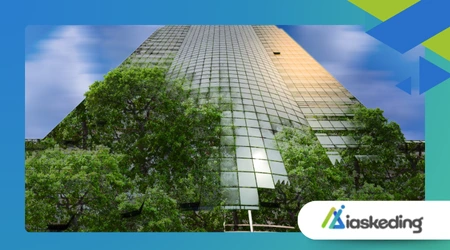
The Economic Case: Why Sustainability Pays Off
Critics claim green buildings are too expensive, but lifecycle costs tell a different story.
A 2024 Dodge Construction Network study found that LEED-certified buildings command 7% higher rents and 20% faster lease-ups.
Consider the Edge in Amsterdam: its smart sensors cut energy use by 70%, saving $200,000 annually.
Read more: The Future of Renewable Energy: What’s Next After Solar and Wind?
Even retrofits, like London’s The Crystal, achieve payback in under five years through energy savings.
For investors, the math is clear. BlackRock’s 2025 Global Sustainability Report notes that ESG-compliant real estate assets outperform conventional ones by 4.2% annually.
Challenges: The Roadblocks to Mass Adoption
Despite progress, hurdles persist. Upfront costs deter small developers, though green bonds and tax incentives (like the U.S.’s Inflation Reduction Act) are bridging gaps.
Supply chain bottlenecks also delay material access. Cross-laminated timber (CLT) demand has surged 300% since 2020, outstripping production.
Meanwhile, inconsistent global standards confuse builders—while the EU mandates near-zero emissions, some regions lack clear policies.
++The Science Behind Hydropower: How Water Can Power the Future
Yet, pioneers like Sidewalk Labs prove smart cities can work. Their Toronto project (now paused) aimed for 75% lower carbon emissions using mass timber and underground waste systems.
The Future: Where Do We Go From Here?
By 2030, the World Bank estimates 70% of new construction will be in emerging markets. If these nations adopt green buildings now, they’ll leapfrog outdated infrastructure entirely.
Technologies like 3D-printed homes (see ICON’s Texas developments) and carbon-absorbing paint (Bosch’s photocatalytic coatings) hint at a radically sustainable future.
Will your next office be net-zero? Will your home generate its own power? The tools exist—the will must follow.
The Role of Policy and Incentives in Accelerating Green Construction
Governments worldwide are stepping up to mandate sustainable construction, recognizing that voluntary measures aren’t enough.
The European Union’s Renovation Wave initiative aims to double annual energy renovation rates by 2030, targeting 35 million inefficient buildings.
In the U.S., states like California now require all new commercial buildings to achieve net-zero energy status, while cities like Vancouver have implemented embodied carbon limits for structural materials.
These policies create a domino effect—when major markets demand green buildings, global supply chains adapt faster.
Tax credits, expedited permitting for sustainable projects, and density bonuses for developers who exceed environmental standards are proving effective.
For instance, Singapore’s Green Mark Incentive Scheme has spurred over 4,000 certified projects since 2005 by offering cash rewards and additional floor area ratios.
The Human Factor: Health, Productivity, and Social Equity
Beyond energy metrics, green buildings are revolutionizing indoor environmental quality—a crucial factor as people spend 90% of their time inside.
Harvard studies show workers in WELL-certified offices demonstrate 26% higher cognitive function, while schools with proper ventilation report 20% faster test scores.
But sustainability must also address affordability. Projects like Via Verde in the Bronx combine low-income housing with rooftop farms and solar arrays, proving eco-design isn’t just for luxury developments.
The next frontier? Circular social housing—where modular, recyclable units paired with community energy microgrids could democratize access to sustainable living.
As climate migration intensifies, resilient, healthy shelters will become a basic human right, not a premium feature.
Frequently Asked Questions
Q: Are green buildings more expensive to construct?
A: Initially, yes—by 2-7%. But lower operating costs mean ROI in 3-7 years, per McGraw-Hill Construction.
Q: Can old buildings become green?
A: Absolutely. The Empire State Building’s retrofit cut emissions by 40%, proving age isn’t a barrier.
Q: What’s the most overlooked green building feature?
A: Natural ventilation. Proper airflow can reduce AC use by 50%, says the American Institute of Architects.
Q: How do I verify a building’s sustainability?
A: Look for certifications like LEED, BREEAM, or WELL—they audit energy, water, and health metrics.
Final Thoughts
The built environment must evolve—or collapse under its own waste. Green buildings aren’t a luxury; they’re the blueprint for survival. From policy shifts to consumer demand, every lever must be pulled.
The revolution won’t be televised. It’ll be constructed.
