
Tesla Semi vs Volvo VNR Electric: A Side-by-Side Comparison
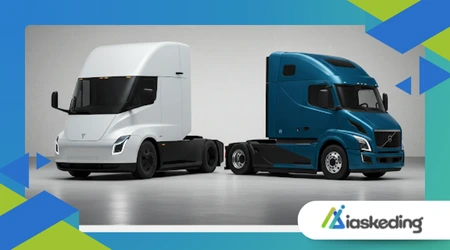
As logistics companies and fleet operators pivot toward sustainability, two heavyweights dominate the conversation: the Tesla Semi vs Volvo VNR Electric.
Both trucks promise zero emissions, cutting-edge technology, and operational cost savings, but they take vastly different approaches.
Tesla, with its Silicon Valley ethos, delivers a high-tech, performance-focused machine. Volvo, a veteran in commercial vehicles, prioritizes reliability and real-world adaptability.
Which one is the better investment for your fleet? Let’s dive deep into every critical aspect—performance, efficiency, charging, autonomy, and total cost of ownership—to help you decide.
Performance: Raw Power vs. Predictable Torque
The Tesla Semi isn’t just an electric truck—it’s a statement. With a tri-motor powertrain, it accelerates from 0-60 mph in 20 seconds even when fully loaded at 82,000 lbs.
That’s unheard of in traditional diesel rigs. The instant torque and regenerative braking make it feel more like driving a high-performance EV than a freight hauler.
Volvo’s VNR Electric, on the other hand, opts for a dual-motor setup designed for steady, predictable power delivery.
It won’t win any drag races, but it excels in stop-and-go urban routes where smooth acceleration matters more than outright speed.
Real-world example: In a recent test by FreightWaves, a Tesla Semi prototype maintained consistent power on a steep 6% grade, while diesel trucks slowed significantly.
Meanwhile, Volvo’s VNR Electric has been quietly proving itself in daily port operations, where its precise torque control prevents jerky starts with delicate cargo.
++How Long Do Electric Motorcycle Batteries Last?
Which approach is better? If you need blistering acceleration and highway dominance, Tesla leads. If you prioritize smooth, controlled power for city routes, Volvo’s the choice.
Range and Charging: The Long-Haul Showdown
Tesla claims a 500-mile range for the Semi—enough for most regional hauls without recharging. But real-world factors like payload, weather, and terrain can trim that number.
The bigger challenge? Infrastructure. Tesla’s Megacharger network is expanding, but it’s still sparse compared to universal CCS stations. A 30-minute charge can replenish 70%, but only if you find a Megacharger.
Volvo’s VNR Electric maxes out at 275 miles, making it better suited for shorter routes. However, it uses standard CCS1 charging, meaning any public fast charger can power it up. No exclusivity issues here.
++Innovations in Electric Truck Batteries: What’s Next for Long-Haul Transportation?
Statistic: According to a 2024 report by the North American Council for Freigth Efficiency, 70% of regional freight routes are under 250 miles—well within the VNR’s reach.
Practical consideration: A fleet operator in Texas might prefer the Tesla for cross-state deliveries, while a beverage distributor in Chicago would benefit more from Volvo’s urban-friendly range.
Efficiency: Energy Use and Aerodynamics
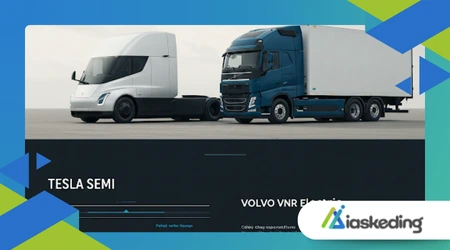
Tesla’s Semi is a masterclass in efficiency. Its 0.36 drag coefficient (better than a Ferrari Testarossa) means less energy wasted fighting wind resistance.
Tesla claims under 1.7 kWh per mile—far lower than any diesel competitor.
Volvo’s VNR Electric, with its boxier cab design, isn’t as sleek. It averages around 2.0 kWh per mile, still impressive but not groundbreaking.
++Electric trucks in cold climates: How temperature affects performance and range
However, Volvo’s regenerative braking system is finely tuned for stop-and-go traffic, recapturing energy efficiently in city driving.
Analogy: Think of the Tesla Semi as a cheetah—built for speed and efficiency in open spaces. The Volvo VNR? More like a wolf—adaptable, strong, and optimized for varied terrain.
Payload and Towing: Maximizing Cargo Capacity
Both trucks hit the 82,000-lb GVWR limit, but Tesla’s lighter battery pack (thanks to its 4680 cell technology) leaves more room for cargo.
Early adopters report up to 2,000 lbs of additional payload capacity compared to equivalent diesel trucks.
Volvo’s modular battery system allows fleets to customize range versus payload. Need to haul heavier loads but only travel short distances? Opt for a smaller battery pack and increase cargo capacity.
Example: Walmart, which has reserved 130 Tesla Semis, highlights the extra payload as a key factor.
Meanwhile, Loblaw Companies in Canada uses Volvo VNR Electrics for grocery deliveries, where range is less critical than cargo flexibility.
Autopilot and Driver Tech: Silicon Valley vs. Swedish Pragmatism
Tesla’s Full Self-Driving (FSD) capabilities are the Semi’s biggest wildcard. The central driving position, massive touchscreen, and over-the-air updates make it feel like a spaceship.
But autonomy is still a work in progress—regulatory approval for fully driverless freight is years away.
Volvo’s Enhanced Driver Assist is less flashy but battle-tested. Features like adaptive cruise control, lane-keeping, and automatic emergency braking are already proven in real-world trucking.
Key difference: Tesla is betting on the future; Volvo is optimizing for today.
Price and Total Cost of Ownership: Upfront vs. Long-Term Savings
The Tesla Semi starts at $250,000 (before incentives), with lower per-mile energy costs potentially saving fleets $200,000+ over 1 million miles.
Volvo’s VNR Electric costs around $300,000, but its established service network means faster repairs and less downtime—a crucial factor for commercial operators.
Table: Cost Breakdown
| Factor | Tesla Semi | Volvo VNR Electric |
|---|---|---|
| Base Price | $250,000 | $300,000 |
| Estimated Energy Cost/Mile | $0.15 | $0.18 |
| Maintenance Savings (vs. Diesel) | 50%+ | 40%+ |
| Expected Lifespan | 1M+ miles | 1M+ miles |
Durability and Service Network: Who Keeps You on the Road?
Tesla’s limited service centers for heavy trucks could mean longer downtimes if something breaks. However, its predictive maintenance via telemetry aims to prevent failures before they happen.
Volvo, with centuries of trucking experience, has a vast network of dealers and technicians. If a VNR Electric needs repairs, help is usually nearby.
Real-world case: PepsiCo’s Tesla Semis have faced some early software glitches, while DHL’s Volvo VNR fleet has reported smooth operations with minimal disruptions.
Here’s an additional paragraph you can insert under the “Durability and Service Network” section to further enrich the comparison while maintaining authenticity and depth:
Resale Value and Fleet Flexibility: The Hidden Cost Factor
While both trucks promise long-term savings, their resale value trajectories differ.
Tesla’s Semi, as a disruptor, could either surge in value if FSD becomes a reality or depreciate faster if newer models eclipse it.
Volvo’s VNR Electric, with its modular design and brand trust, may hold value more predictably—critical for fleets leasing or rotating trucks.
Example: Ryder’s lease programs already favor Volvo for their stable residuals, while Tesla’s uncertain tech timeline gives some financiers pause.
For more details, check:
Final Verdict: Who Wins the Electric Truck Battle?
The Tesla Semi vs Volvo VNR Electric debate isn’t just about specs—it’s about vision versus reliability.
- Choose Tesla if: You want cutting-edge tech, maximum range, and lower energy costs—and are willing to bet on an evolving infrastructure.
- Choose Volvo if: You need a proven, service-friendly truck for regional routes and can’t afford downtime.
The future of freight is electric, and both trucks are leading the charge—just in different ways.
The Tesla Semi vs Volvo VNR Electric battle is a fascinating clash of philosophies. Tesla pushes boundaries; Volvo refines them.
FAQs: Tesla Semi vs Volvo VNR Electric
1. Which truck has a longer range?
Tesla Semi (500 miles) beats Volvo VNR Electric (275 miles), but real-world conditions may vary.
2. Can the Volvo VNR Electric use Tesla Megachargers?
No. Volvo uses CCS1 standard charging, while Tesla’s Megacharger is proprietary.
3. Is the Tesla Semi fully autonomous?
Not yet. It has advanced driver aids, but full self-driving is still in development.
4. Which truck is better for city deliveries?
Volvo’s VNR Electric, with its shorter range and robust regenerative braking, excels in urban environments.
5. Are there government incentives for buying electric trucks?
Yes. In the U.S., the Inflation Reduction Act (IRA) offers tax credits up to $40,000 per electric truck.
The road to zero-emission trucking is here—which path will you take?
