
Electric Trucks and Off-Roading: Performance Beyond Pavement
Off-road electric vehicles are shaking up the world of rugged adventure. These powerful machines are redefining what’s possible when the pavement ends. With electric truck capabilities that rival and often surpass their gas-guzzling cousins, EV off-roading is no longer a distant dream.
Electric trucks bring a new edge to trail-blazing. Their instant torque delivers a thrilling punch, while smart weight distribution enhances stability on tricky terrain. As we dive into the world of electric off-roading, get ready to discover how these high-tech trucks are conquering nature’s toughest challenges.
The Evolution of Electric Trucks in Off-Road Applications
Electric truck history traces back to the early 20th century. These early models lacked power and range for off-road use. The first attempts at EV off-road development faced significant hurdles. Limited battery life and weak motors restricted their capabilities on challenging terrain.
Battery technology advancements in the 1990s sparked renewed interest in electric vehicles. Lithium-ion batteries offered improved energy density and longevity. This breakthrough paved the way for more powerful electric motors. Suddenly, the dream of capable electric off-roaders seemed within reach.
The 2000s saw rapid progress in EV off-road development. Manufacturers began integrating electric powertrains into rugged vehicle designs. These prototypes demonstrated impressive torque and instant power delivery. Such characteristics proved ideal for navigating steep inclines and rocky paths.
“Electric motors’ instant torque revolutionized off-road vehicle performance, offering unparalleled control in challenging terrain.”
Today, electric trucks are pushing boundaries in off-road capabilities. Advanced battery management systems extend range and durability. Regenerative braking recaptures energy during descents. Sophisticated motor controls allow for precise power distribution to each wheel. These innovations have transformed electric trucks into formidable off-road machines.
- Improved battery energy density
- Enhanced motor efficiency
- Advanced power management systems
- Integrated regenerative braking
The journey of electric trucks from city streets to rugged trails showcases remarkable technological progress. As battery technology continues to advance, the future of electric off-roading looks brighter than ever.
Off-Road Electric Truck Performance: Core Capabilities
Electric trucks are revolutionizing off-road performance with impressive capabilities. Electric truck torque stands out as a game-changer for trail conquering. These vehicles deliver instant power, allowing drivers to navigate steep inclines and rocky terrain with ease.
EV ground clearance often surpasses that of traditional trucks. The strategic placement of batteries in the vehicle’s floor creates a lower center of gravity, enhancing stability on uneven surfaces. This design also protects vital components from damage during rugged adventures.
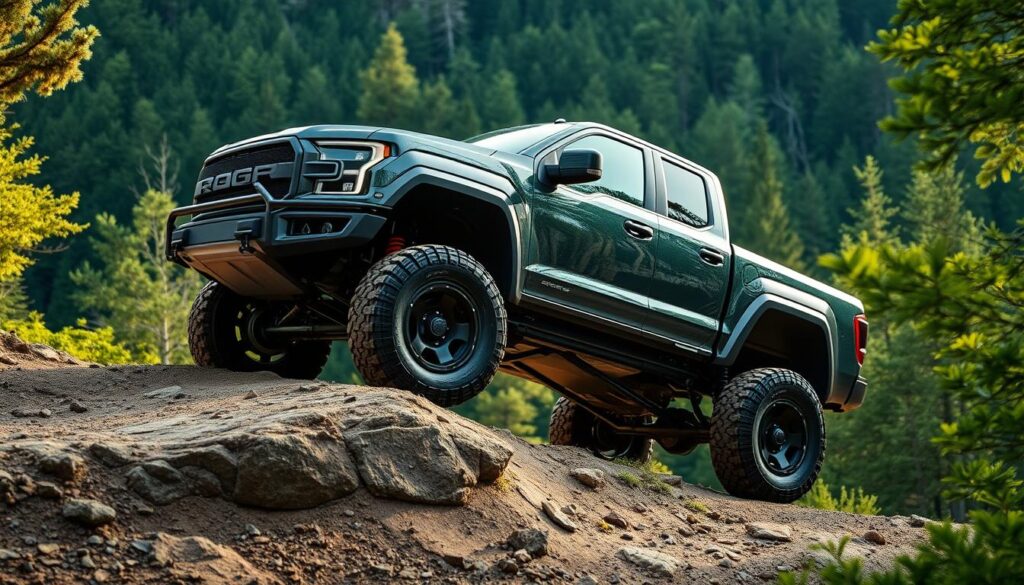
Battery range off-road remains a crucial factor for adventurers. While electric trucks offer substantial range on highways, off-road conditions can impact energy consumption. Factors like terrain difficulty, payload, and weather affect how far these vehicles can travel on a single charge.
| Performance Metric | Electric Trucks | Traditional Trucks |
|---|---|---|
| Torque Delivery | Instant | Gradual |
| Ground Clearance | High (10-14 inches) | Moderate (8-10 inches) |
| Off-Road Range | 150-300 miles | 300-500 miles |
Leading electric truck models showcase these core capabilities. The Rivian R1T boasts a ground clearance of up to 14.9 inches, while the GMC Hummer EV delivers an impressive 11,500 lb-ft of wheel torque. These features demonstrate the potential of electric vehicles in challenging off-road environments.
Advanced Electric Drivetrain Technology for Trail Navigation
Electric 4WD systems are revolutionizing off-road adventures. These cutting-edge drivetrains offer unparalleled control and performance on challenging terrain. With individual wheel motors, electric trucks can navigate rocky paths and steep inclines with ease.
Regenerative braking off-road is a game-changer for trail enthusiasts. This technology not only extends battery life but also provides enhanced control during descents. By converting kinetic energy into electrical power, electric trucks can tackle downhill sections with precision and efficiency.
Motor torque vectoring takes off-road capabilities to new heights. This innovative feature allows for precise power distribution to each wheel, optimizing traction in slippery or uneven conditions. The result is improved maneuverability and stability, even in the most challenging off-road scenarios.
“Electric drivetrains are redefining what’s possible in off-road adventures, offering unprecedented control and efficiency.”
The advantages of electric drivetrain technology extend beyond performance. These systems offer quieter operation, allowing drivers to fully immerse themselves in nature without disturbing wildlife. Additionally, the instant torque delivery of electric motors provides superior responsiveness when navigating obstacles.
- Enhanced traction control
- Improved power distribution
- Quieter operation
- Instant torque delivery
As electric 4WD systems continue to evolve, off-road enthusiasts can look forward to even more advanced features and capabilities. The future of trail navigation is electric, promising exciting adventures with minimal environmental impact.
Electric vs. Traditional Off-Road Vehicles: Comparative Analysis
In the EV vs ICE off-road battle, electric trucks are gaining ground. Their instant torque gives them an edge on steep climbs and rough terrain. A study on vehicle efficiency shows electric vehicles outperform diesel counterparts across various duty cycles.

- Quieter operation, enhancing the outdoor experience
- Lower center of gravity for improved stability
- Reduced maintenance needs with fewer moving parts
- Zero emissions for eco-friendly adventures
In a traditional 4×4 comparison, EVs excel in low-speed maneuvers. Their precise torque control allows for better traction in muddy or sandy conditions. While ICE vehicles still have an edge in range, rapid advancements in battery technology are closing this gap.
| Feature | Electric Off-Road | Traditional 4×4 |
|---|---|---|
| Torque Delivery | Instant | Gradual |
| Maintenance | Low | High |
| Environmental Impact | Minimal | Significant |
Real-world tests show electric trucks climbing steep grades with ease. Their regenerative braking system proves valuable during descents, recharging batteries and reducing wear on brake components. As technology progresses, the line between EV and ICE off-road capabilities continues to blur, with electric vehicles increasingly proving their worth in challenging terrains.
Charging Infrastructure for Remote Adventures
Electric truck owners venturing off-road face unique challenges when it comes to charging. Remote locations often lack traditional charging stations, making off-grid charging solutions essential. Portable EV chargers have emerged as a game-changer for adventurers, offering flexibility and peace of mind during extended trips.
Solar charging for trucks is gaining traction among off-road enthusiasts. These systems harness the sun’s energy, providing a sustainable power source even in the most isolated areas. Lightweight, foldable solar panels can be easily stored and deployed when needed, ensuring a continuous power supply for electric vehicles.
Innovative companies are developing rugged charging stations for popular off-road destinations. These stations are designed to withstand harsh environments and provide reliable charging options for electric truck owners exploring remote terrains.
| Charging Solution | Advantages | Limitations |
|---|---|---|
| Portable EV Chargers | Compact, versatile, easy to transport | Limited charging capacity |
| Solar Charging Systems | Sustainable, silent operation | Weather-dependent, slower charging |
| Rugged Charging Stations | High-power output, built for extreme conditions | Fixed location, limited availability |
As electric trucks gain popularity in off-road applications, the demand for efficient and reliable charging infrastructure continues to grow. Manufacturers and outdoor enthusiasts alike are driving innovation in this space, paving the way for exciting adventures in electric-powered vehicles.
Terrain Management Systems in Electric Off-Roaders
Electric trucks are revolutionizing off-road driving with advanced terrain management systems. These innovative off-road vehicle control systems offer precise performance across various landscapes. Unlike traditional vehicles, electric trucks utilize their powertrains for enhanced traction and stability.
Electric truck driving modes adapt to different terrains automatically. Sensors detect surface conditions and adjust power delivery instantly. This results in smoother rides and better control on challenging paths. Drivers can also select specific modes for mud, sand, or rocks with the touch of a button.
Adaptive suspension plays a crucial role in electric off-roaders. It continuously adjusts to terrain changes, providing optimal ground clearance and ride comfort. The system can lower the vehicle for improved aerodynamics on highways or raise it for extra clearance on rough trails.
- Mud mode: Optimizes wheel spin for maximum traction
- Rock crawl: Provides precise torque control for obstacle navigation
- Sand mode: Allows controlled wheel slip for dune traversing
Electric powertrains enable finer control over each wheel independently. This level of precision was previously unattainable with mechanical systems. As a result, electric off-roaders can tackle more extreme terrains with greater ease and safety.
“Electric trucks are redefining off-road capabilities with their advanced terrain management systems.”
As technology progresses, we can expect even more sophisticated off-road vehicle control systems in electric trucks. These advancements will continue to push the boundaries of what’s possible in off-road adventures.
Future Innovations in Electric Off-Road Technology
The future of electric off-road vehicles is bright with exciting innovations on the horizon. Solid-state batteries for off-roading are set to revolutionize the industry. These advanced power sources promise longer range, faster charging, and improved durability in harsh conditions. Off-road enthusiasts can look forward to extended adventures without compromising performance.
AI-assisted off-road driving is another game-changing technology in development. Smart systems will analyze terrain in real-time, adjusting vehicle settings for optimal traction and efficiency. This technology will make challenging trails more accessible to novice drivers while enhancing safety for all.
Electric truck modular design is gaining traction among manufacturers. This approach allows for customizable off-road setups, catering to diverse user needs. Imagine swapping out battery packs, suspension components, or even entire drive units to suit specific terrains or trip durations.
“The future of off-roading is electric, intelligent, and adaptable. We’re witnessing a new era of adventure vehicles.”
Ford’s recent unveiling of the F-150 Lightning Switchgear demonstrates the potential of electric off-road innovation. This concept vehicle serves as a testing ground for cutting-edge technologies that may soon become standard in production models.
- Advanced torque vectoring for precise control
- Self-healing exterior coatings for durability
- Integrated solar panels for on-the-go charging
As these technologies mature, electric off-road vehicles will offer unparalleled performance, reliability, and versatility. The future of adventure is charged with excitement and endless possibilities.
Conclusion
The electric off-road revolution is reshaping how we think about adventure vehicles. Electric trucks are not just keeping up with their gas-powered cousins; they’re blazing new trails. These high-tech machines offer instant torque, silent operation, and impressive range, making them ideal for sustainable off-roading.
As battery tech improves and charging stations pop up in remote areas, the future of adventure vehicles looks bright. Electric off-roaders are proving they can handle tough terrain while being kinder to the environment. This blend of power and eco-friendliness is winning over more outdoor enthusiasts every day.
The shift towards electric trucks in off-road applications marks a turning point for outdoor recreation. With advanced features like regenerative braking and adjustable ride height, these vehicles are setting new standards for performance and versatility. As we look ahead, it’s clear that electric powertrains will play a big role in shaping the future of off-road adventures.
FAQ
How do electric trucks perform in off-road conditions compared to traditional 4×4 vehicles?
What’s the range of an electric truck when off-roading?
How do I charge my electric truck during remote off-road adventures?
Are electric trucks capable of handling extreme off-road conditions?
What advantages do electric trucks have over traditional off-road vehicles?
How does regenerative braking benefit off-road driving?
What future innovations can we expect in electric off-road technology?
