
Electric Ground Support Equipment (eGSE): How Airports Are Transitioning to Zero-Emission
The adoption of Electric Ground Support Equipment (eGSE) has emerged as the most practical catalyst for the aviation industry’s shift toward net-zero operations in 2026.
While sustainable aviation fuels (SAF) and hydrogen-powered aircraft grab the headlines, the real decarbonization work is happening silently on the tarmac.
Airports globally are replacing diesel-guzzling tractors, loaders, and belts with high-efficiency electric alternatives that slash local emissions and noise pollution.
This transition represents a fundamental change in ramp operations, demanding new infrastructure and a digital-first approach to energy management.
In this guide, we will explore the logistical hurdles, the undeniable financial benefits, and the technological breakthroughs driving this electrified airport revolution.
By understanding these shifts, industry stakeholders can better navigate the complex roadmap toward a truly green aviation ecosystem.
What is Electric Ground Support Equipment (eGSE)?
Ground support equipment encompasses the diverse fleet of vehicles required to service an aircraft between its arrival at a gate and its subsequent departure.
Traditionally, these machines relied on heavy-duty diesel engines, contributing significantly to an airport’s total carbon footprint and local particulate matter levels.
The shift toward Electric Ground Support Equipment (eGSE) replaces these combustion engines with lithium-ion or solid-state battery systems.
This includes everything from pushback tractors and baggage tugs to belt loaders and passenger stairs, creating a cleaner, quieter environment for both travelers and ramp staff.
In 2026, the term has expanded to include “smart” connected assets that optimize energy consumption based on real-time flight schedules.
This intelligence ensures that equipment is charged during off-peak hours, preventing grid overloads while maintaining 24/7 operational readiness in high-traffic hubs.
How does eGSE improve airport worker health and safety?
Beyond carbon metrics, the transition to electric fleets addresses a critical human factor: the harsh environment of the airport ramp.
Diesel engines produce toxic nitrogen oxides (NOx) and fine particulates that ramp agents breathe daily, often in enclosed or semi-enclosed spaces.
By deploying Electric Ground Support Equipment (eGSE), airports effectively eliminate these localized tailpipe emissions, leading to a measurable decrease in respiratory-related health issues among ground crews.
It is a vital step toward modernizing labor standards in a demanding industry.
Noise reduction is another transformative benefit that is often underestimated in technical discussions.
Electric motors operate at a fraction of the decibel level of diesel counterparts, reducing the risk of long-term hearing loss and improving verbal communication between crew members, which directly enhances safety.
Why are airports choosing electric over traditional diesel in 2026?
The primary driver is no longer just “green PR” but a hard-nosed financial reality regarding total cost of ownership (TCO).
While the upfront purchase price of electric units remains higher, the drastic reduction in moving parts simplifies the maintenance schedule.
Diesel GSE requires frequent oil changes, filter replacements, and exhaust system repairs due to heavy idling times.
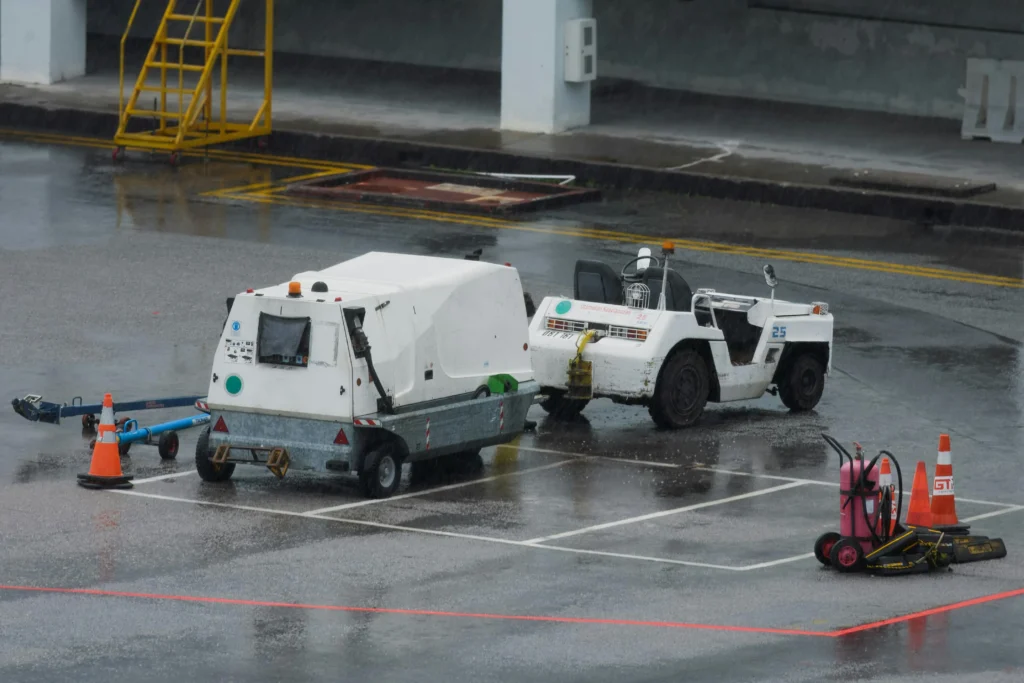
In contrast, Electric Ground Support Equipment (eGSE) thrives in the stop-and-go nature of airport operations, losing almost no energy while waiting for an aircraft to arrive at the gate.
For a deeper look at the technical standards and safety regulations governing these new fleets, the International Air Transport Association (IATA) provides the industry-standard Ground Operations Manual (IGOM), which now includes specific chapters on electric asset management.
Performance Comparison (Diesel vs. eGSE)
| Equipment Category | Diesel Fuel Consumption (Avg) | eGSE Energy Use (kWh) | Maintenance Savings (%) | Noise Level (dB) |
| Pushback Tractor | 12.5 Liters/Hour | 18 – 25 kWh | 35% – 40% | 65 dB |
| Baggage Tug | 4.2 Liters/Hour | 5 – 8 kWh | 50% | 60 dB |
| Belt Loader | 3.8 Liters/Hour | 4 – 6 kWh | 45% | 55 dB |
| Ground Power Unit | 15.0 Liters/Hour | 30 – 45 kWh | 30% | 70 dB |
| Air Start Unit | 45.0 Liters/Hour | 110 – 150 kWh | 25% | 85 dB |
Which infrastructure hurdles must airports overcome?
The biggest challenge facing the industry isn’t the vehicles themselves, but the power required to charge them.
Many older airports were never designed to deliver megawatts of electricity to the remote stands where ground equipment is parked and serviced.
Modernizing these grids requires significant capital expenditure on transformers, fast-charging stations, and energy storage systems.
Read more: Top Green Energy Startups to Watch
To manage this, many hubs are implementing “opportunity charging,” where Electric Ground Support Equipment (eGSE) is topped up during short breaks between aircraft turns, rather than overnight.
There is something inquietante about how some airports announce “green” goals without addressing their aging electrical infrastructure.
Without a robust, smart grid that can prioritize charging based on flight priority, a fully electric ramp can lead to logistical bottlenecks that delay departures.
How does eGSE contribute to an airport’s ESG goals?
Environmental, Social, and Governance (ESG) criteria are now central to how airports secure funding and public operating licenses.
Reducing Scope 1 and Scope 2 emissions through electrification is the most direct way for an airport operator to demonstrate tangible progress.
Learn more: Electric Vertical Take-Off and Landing (eVTOL): Are Flying Taxis Ready for 2026?
Implementing Electric Ground Support Equipment (eGSE) allows airports to market themselves as “Green Gateways,” which is increasingly important for attracting climate-conscious airlines.

Many carriers now prioritize hubs that offer subsidized electric charging or carbon-neutral ground handling services as part of their partnership.
Socially, the reduction in noise and smog benefits the surrounding communities that often live under the flight paths.
This localized environmental justice is a powerful argument for city-owned airports looking to maintain a positive relationship with their neighbors while expanding their operational capacity.
What is the future of autonomous and electric ramp operations?
As we look toward 2030, the convergence of electrification and automation will redefine the tarmac.
We are already seeing pilot programs for autonomous baggage tugs that follow pre-programmed paths without human intervention, further increasing the efficiency of the electric powertrain.
Read more: Autonomous Driving Meets Electric Cars: What’s on the Horizon
The data gathered from Electric Ground Support Equipment (eGSE) sensors allows for “predictive maintenance,” where a vehicle alerts the workshop before a failure occurs.
This connectivity ensures that the fleet is always at peak performance, minimizing the risk of a ground-handling delay affecting thousands of passengers.
Finalizing this transition requires a global commitment to standardized charging plugs and communication protocols.
For more information on the global policy frameworks supporting this change, the International Civil Aviation Organization (ICAO) offers detailed environmental reports on the roadmap to 2050.
The path is clear: the future of airport ground operations is electric, silent, and connected.
By investing today, airports are ensuring their relevance in a world that no longer accepts carbon-intensive travel as the status quo.
FAQ: Frequently Asked Questions
Does eGSE work in extremely cold climates?
Modern lithium-ion batteries used in GSE are equipped with thermal management systems. These systems heat the batteries during charging and operation to maintain performance even in sub-zero temperatures found in northern hubs like Anchorage or Oslo.
How long does it take to charge a large pushback tractor?
Using high-speed DC chargers, a pushback tractor can reach 80% charge in about 60 to 90 minutes. However, most operators use “opportunity charging” to keep the battery between 40% and 80% throughout the workday.
What is the lifespan of an eGSE battery?
In a typical airport environment, these batteries are designed to last between 8 and 12 years. Once they drop below 80% capacity, they are often repurposed for “second-life” stationary energy storage at the airport.
Can eGSE handle the heaviest long-haul aircraft?
Yes. Electric pushback tractors are now capable of moving the largest aircraft, including the Airbus A380 and Boeing 777X. The high torque of electric motors actually makes them superior to diesel for moving massive loads from a standstill.
Is it possible to convert old diesel GSE to electric?
Retrofitting is possible and common for certain types of equipment like belt loaders. However, for heavier machinery, it is often more cost-effective to purchase a purpose-built electric unit designed with optimized weight distribution and integrated telematics.
