
The Future of Long-Haul Electric Trucks: Technology and Challenges
The future of long-haul electric trucks is a topic generating substantial interest as the world pivots towards sustainable trucking solutions. With the trucking industry transporting 71.6 percent of U.S. goods, totaling $10.4 trillion annually, it is a crucial player in our economy. However, trucks also emitted seven percent of the country’s greenhouse gas (GHG) emissions in 2020, making electric transportation a promising alternative.
Several major fleets have committed to transition at least 30% of new heavy-duty truck purchases to zero-emission vehicles, including electric models, by 2030. This shift towards zero-emission trucking could prevent 66,800 premature deaths, 1.75 million asthma attacks, and 8.5 million lost workdays between 2020 and 2050, translating to $735 billion in cumulative U.S. public health benefits. Additionally, an electric semi-truck with a 375-mile range has been found to have a 13% lower total cost of ownership compared to diesel models, potentially leading to significant savings over a 15-year period.
Despite these advantages, the transition is not without its challenges. The initial costs of electric semi-trucks are currently up to 2.8 times higher than their diesel counterparts, posing a significant barrier for many companies. The United States has 6,700 public DC fast-charging stations; however, options for heavy-duty trucks remain limited. Fleet operators can take advantage of tax credits and incentives like up to $40,000 per electric truck under the Inflation Reduction Act, which eases some of the financial burdens.
Policies such as California’s Advanced Clean Trucks (ACT) regulation and the National Electric Vehicle Infrastructure Formula Program are setting clear targets and building necessary infrastructure to support electric trucks. Programs like the Hybrid and Zero-Emission Truck and Bus Voucher Incentive Project (HVIP) and Low Carbon Fuel Standard (LCFS) are also making the transition more financially feasible for companies.
As the industry continues to evolve, innovations in battery technology and the development of charging infrastructure are making electric trucks an increasingly viable option for long-haul routes. The latest models now boast ranges of up to 500 miles on a single charge, with some solid-state battery prototypes showing the potential to charge to 80% capacity in just 15 minutes. Major manufacturers like Tesla, Daimler, Volvo, and Ford are investing heavily in electric truck development, signaling a dynamic shift in the landscape of green logistics and electric transportation.
Introduction to Long-Haul Electric Trucks
Long-haul electric trucks represent an exciting evolution in the transportation industry, addressing the pressing need for more sustainable and environmentally friendly solutions. As zero-emission vehicles, electric semi-trucks offer a significant reduction in greenhouse gas emissions compared to their diesel-powered counterparts. This shift to clean energy transportation is not only beneficial for the planet but also holds promise for the health and economic wellbeing of society.
In Europe, nearly 45% of road-transported goods travel less than 300 kilometers, making them ideal for the current capabilities of electric trucks. Interestingly, data shows that 45% of trucks in Europe cover daily distances of less than 350 kilometers, while 33% of trucks globally manage less than 500 kilometers per day. These statistics highlight the growing potential for wider adoption of zero-emission vehicles in long-haul logistics.
Practically speaking, strategic charger placement plays a crucial role in extending the range of electric semi-trucks. For instance, in Sweden, electric trucks are used for routes like Gothenburg to Jönköping, a span of 450 kilometers each day with stops approximately every 150 kilometers. Furthermore, new public charging stations enable round trips between Gothenburg and Malmö, covering a total distance of 270 kilometers efficiently.
It’s noteworthy that in 2022, long-haul trucks moved 71% of all freight in the United States and accounted for over 3% of carbon dioxide emissions. This underscores the magnitude of environmental impact that shifting to electric long-haul trucks could mitigate. With global demand for freight transport projected to potentially double by 2050, the transition towards electric semi-trucks is timely and essential.
Below is a comparison of the distances covered by traditional trucks and zero-emission vehicles on strategic routes:
| Route | Distance (km) | Electric Trucks Usage Example |
|---|---|---|
| Gothenburg to Jönköping | 450 | Electric trucks covering 450 km daily |
| Gothenburg to Malmö | 270 | Two return trips daily using public charging stations |
| Home Depot Radius | 120 | Limited to 120 km with overnight charge |
By transitioning to electric semi-trucks and clean energy transportation, the transportation industry is not just adapting to the future but actively shaping it, ensuring a sustainable and economically viable pathway for long-haul freight.
Advantages of Long-Haul Electric Trucks
Electric truck benefits are numerous and bring considerable advantages to both the environment and the economy. One of the primary benefits is the significant reduction in greenhouse gas emissions. Electric trucks can achieve up to 63% lower emissions compared to their diesel counterparts, especially when powered by renewable energy sources. This substantial cut in emissions contributes to cleaner air and has the potential to improve public health by preventing diseases linked to air pollution, such as asthma and lung cancer.
Moreover, eco-friendly trucking is not only beneficial for the environment but also brings economic advantages. Electric vehicles (EVs) are roughly 50% more efficient to operate than diesel trucks, making them at least 20% less expensive. The operating cost of EVs is about one-third that of gas-powered vehicles. This efficiency translates into lower ownership costs over the lifespan of the vehicle, which is an attractive aspect for fleet owners.
Eco-friendly truckingalso offers significant potential for cost savings in healthcare. A transition to electric trucks could save up to $735 billion in health-related expenses by 2050, considering the reduced prevalence of respiratory and cardiovascular diseases linked to lower air pollutant levels.
Electric trucks also require less maintenance than diesel trucks. The fewer moving parts in electric drivetrains mean that there is less wear and tear compared to traditional internal combustion engines. This reduced need for maintenance not only lowers costs but also minimizes downtime, enhancing the overall productivity of long-haul operations.
Adopting low-emission vehicles can create a ripple effect through the transportation sector. As barriers such as charging infrastructure and battery technology improve (as discussed here), the integration of electric trucks into long-haul freight operations will likely become even more seamless. The result is a future where eco-friendly trucking is not just a possibility but a mainstream reality.
Challenges in Adopting Electric Semi-Trucks
Despite the numerous benefits, several electric truck adoption barriers remain, making it challenging for the industry to transition from traditional diesel to electric vehicles. One of the primary obstacles is the high upfront costs associated with electric semi-trucks. Currently, these vehicles are priced up to 2.8 times more than their diesel counterparts, primarily due to significant battery costs.
Battery range and charging infrastructure also present formidable obstacles. While models like the Tesla Semi offer a range of 300 to 500 miles on a single charge, the limited availability of public DC fast-charging stations intensifies electric truck adoption barriers. There are less than 7,000 such stations in the US, and most are designed for smaller electric vehicles rather than heavy-duty long haulers.
Moreover, the maintenance and operational costs of electric trucks, while generally lower, come with their own set of challenges. Upfront electric semi-truck costs remain daunting, even though projected costs per mile are more favorable over time. For instance, the North American Council for Freight Efficiency (NACFE) estimates a 40 to 70% reduction in maintenance costs for electric semis compared to diesel trucks. Additionally, a study by Lawrence Berkeley National Lab suggests that an electric semi with a 375-mile range could eventually cost $1.51 per mile versus $1.73 per mile for diesel trucks, potentially saving about $200,000 over 15 years.
Another critical aspect is achieving cost parity between electric and diesel semi-trucks. According to the National Renewable Energy Laboratory (NREL), such parity for smaller zero-emission trucks might be achieved by 2030, while heavier long-haulers could reach this milestone by 2035. Legislative supports and technological advancements are pivotal in overcoming these electric truck adoption barriers.
| Truck Model | Range (Miles) | Fast Charging Time |
|---|---|---|
| Tesla Semi | 300-500 | 70% in 30 min |
| Freightliner eCascadia | 230 | 80% in 90 min |
| Volvo VNR Electric | 275 | 80% in 60-90 min |
| Mercedes Benz eActros | 205-248 | 20% to 80% in 60-90 min |
| Nikola Tre | 330 | 80% in 90 min |
Battery Technology and Range Improvement
The critical factor in the evolution of long-haul electric trucks lies in the continuous improvement of electric truck batteries. These advancements not only enhance EV range enhancement but also ensure more efficient and faster charging times. As we look towards 2030, the European Commission’s target of a 45% reduction in new-vehicle sales emissions compared to 2019 levels emphasizes the need for robust battery solutions.
Over the past decade, the cost of battery packs has plummeted by over 80%, making battery electric trucks a financially attractive option for commercial use. Current models boast well-to-wheel efficiencies ranging from 75% to 85%, significantly reducing operational costs over time. This is in contrast to hydrogen fuel cell electric vehicles, which have efficiencies between 30% and 50%.
Battery technology advancements have made a single charge capable of reaching up to 500 miles, integrated seamlessly into existing haulage operations. The introduction of medium- and heavy-duty zero-emission truck models by more than ten OEMs has played a pivotal role in driving this change. These trucks have a range of up to 500 km in Europe and 700 km in the United States, positioning them well for usage in predictable and regular operations such as distribution or line-haul.
Despite the promising advancements, electric truck batteries must still contend with the faster refueling times of hydrogen-operated trucks, which can be refueled in just 15 to 30 minutes compared to the 2.5 hours needed for a full battery charge. However, the most viable battery compositions for long-haul trucks in the short term seem to be nickel manganese cobalt (NMC) and lithium iron phosphate (LFP), with long-term potential in lithium manganese iron phosphate (LMFP) due to their superior performance and cost efficiency.
By 2025, battery-electric trucks are anticipated to offer a better total cost of ownership for high-mileage and payload-sensitive operations. Furthermore, studies predict that by 2030, more than 20% of transportation will be electrified, with heavy-duty trucks and urban buses leading this transition. Consequently, global demand for batteries in the truck sector is projected to exceed 400 gigawatt-hours (GWh) by 2030 and over 1,700 GWh by 2040.
| Efficiency | Refueling Time | Current Range | |
|---|---|---|---|
| Battery Electric Trucks (BET) | 75%-85% | 2.5 hours | 500 miles |
| Hydrogen Fuel Cell Electric Vehicles (H2-FCEV) | 30%-50% | 15-30 minutes | 500 km/700 km |
The strategic enhancement of EV range enhancement and the reduction in battery costs are set to ensure that by 2040, electric trucks will dominate the market, potentially accounting for up to 90% of new truck sales. This shift will be bolstered by stringent emissions regulations, lower energy costs, and heightened environmental consciousness.
Prominent Electric Truck Models in the Market
As the demand for sustainable transportation solutions rises, several manufacturers have introduced cutting-edge electric semi-truck models and electric freight vehicles catered to diverse operational needs. Foremost among these are the offerings from Volvo and Daimler, whose models are making significant strides in the realm of electric trucking.
Volvo’s VNR Electric trucks are a prime example, providing a range of up to 275 miles and a gross combination weight of 82,000 pounds. These electric freight vehicles are pivotal for Amazon’s distribution network, which is deploying nearly 50 heavy-duty electric trucks in Southern California alone. This initiative marks the largest fleet of electric trucks in any country, with the vehicles expected to travel more than 1 million miles annually without producing any tailpipe emissions.
Similarly, the MAN eTGX and eTGS offer compelling features, positioning themselves as leaders in the electric truck market. The MAN eTGX provides a daily range of up to 800 kilometers and offers up to 400 kW in continuous drive and braking power, while the eTGS comes with flexible battery capacities ranging from 400 kWh to 480 kWh. Additionally, their efficient charging infrastructure, utilizing Combined Charging System (CCS) with up to 375 kW capacity, and Megawatt Charging System (MCS) reaching up to 750 kW, underscores their capability for rapid recharging.
Amazon’s significant investment in renewable energy and electric vehicle infrastructure further complements these advancements. Over 45 direct current (DC) fast chargers have been installed across 11 sites to power these electric semi-truck models, reinforcing the market’s growth trajectory.
| Electric Truck Model | Range | Battery Capacity | Charging Capability |
|---|---|---|---|
| Volvo VNR Electric | 275 miles | 82,000 lbs GVW | Fast charging infrastructure in place |
| MAN eTGX | 800 km | 400 kW | 375 kW (CCS), 750 kW (MCS) |
| MAN eTGS | N/A | 400-480 kWh | 375 kW (CCS), 750 kW (MCS) |
Such substantial advancements and investments portend a bright future for electric freight vehicles, fostering faster adoption and paving the way for environmentally friendly logistics on a global scale.
Federal and State Incentives for Electric Trucks
Federal and state incentives are pivotal in driving the adoption of electric trucks. Prominent among these initiatives is the Inflation Reduction Act, which extends a tax credit covering up to $40,000 of the purchase price for electric trucks starting in 2023. This substantial benefit, paired with state-driven efforts, substantially reduces the financial burden on businesses transitioning to electric vehicles (EVs).
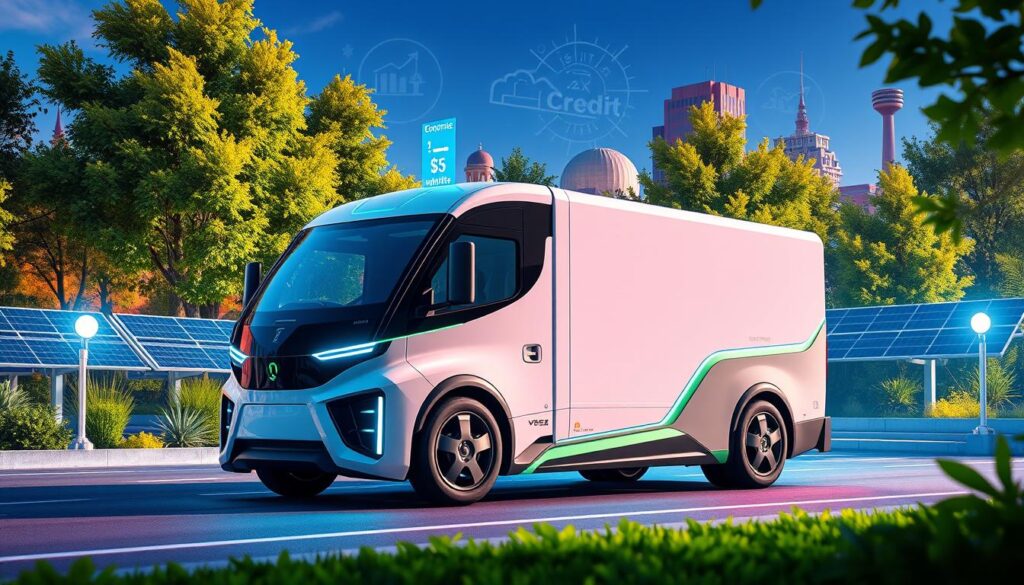
Government subsidies for EVs are another critical component supporting market growth. The federal government can cover up to 30% of the Electric Vehicle Supply Equipment (EVSE) cost, capped at $100,000 per EVSE. This provision encourages more companies to install essential charging infrastructure, facilitating a broader adoption of electric trucks.
California’s Hybrid and Zero-Emission Truck and Bus Voucher Incentive Project (HVIP) is a notable example of state-led initiatives offering up to $120,000 for heavy-duty electric trucks. Additionally, electric school buses can benefit from as much as $375,000 under this program, demonstrating significant forward momentum in promoting zero-emission vehicles.
Moreover, the IRS offers electric truck tax credits up to $7,500 for qualifying plug-in electric vehicles (EVs) or fuel cell vehicles (FCVs). These credits apply to vehicles placed in service from 2023 to 2032, with various income thresholds and vehicle specifications determining eligibility. For example, lower-income brackets and specific battery capacity requirements must be met to qualify for the full credit.
Here’s a comparative table highlighting key federal and state electric truck incentives:
| Incentive | Details |
|---|---|
| Inflation Reduction Act | Up to $40,000 tax credit for electric trucks (2023 onwards) |
| HVIP – California | Up to $120,000 for heavy-duty electric trucks and $375,000 for electric school buses |
| EVSE Funding | Federal government covers up to 30% of installation costs, with a max of $100,000 per EVSE |
| Federal EV Tax Credit | Up to $7,500 for qualifying EVs placed in service (2023-2032) |
Additionally, businesses installing Alternative Fuel Vehicle Refueling Property between January 1, 2023, and December 31, 2032, may receive significant tax credits of up to 30% of depreciable costs, capped at $100,000 per item. This is a key provision supporting the infrastructure crucial for electric trucks.
By leveraging these federal and state incentives, companies can significantly mitigate the initial investment hurdle, accelerating the transition to zero-emission fleets. Therefore, it’s essential for businesses to stay informed and take full advantage of these opportunities to not only benefit economically but also contribute to reducing overall carbon emissions.
Strategic Planning for Charging Infrastructure
Strategic planning for EV charging stations is crucial to facilitate the widespread adoption of electric trucks. According to Germany’s initiative, a network of 350 fast-charging sites aims to cover about 95% of Germany’s federal highways. This deployment will significantly boost the accessibility of electric truck charging solutions, making it easier for drivers to find reliable charging points and maintain their routes without excessive detours.
Key factors to consider in this strategic planning include route optimization, driver schedules, and battery range. Ensuring that shipment needs are met involves breaking up routes into segments with strategically placed EV charging stations. This approach minimizes downtime and maximizes efficiency by leveraging digital intelligence to optimize routes and charge amounts, reducing both electricity usage costs and overall charging infrastructure expenditures.
Investing in charging infrastructure is financially substantial yet vital. By 2030, Europe will require over 300,000 public and private charge points, a significant increase from approximately 10,000 in 2021. Building out such robust networks necessitates capital investments nearing €40 billion until 2040, of which €7 billion is required by 2030. Strategic placement of these stations, especially near major industrial sites or logistics hubs, will represent around 90% of the required infrastructure, totaling an investment of €5.5 billion by 2030.
Forecasting energy consumption based on data models is another essential strategy. Accurate predictions ensure grid availability, allowing multiple vehicles to share the same charging outlets efficiently. For cost-efficient electric truck transportation, electric truck charging solutions must also think about solutions to lower en route charging prices, which currently stand significantly higher than on-site company charging. This is where providers might benefit from incentives like free land access to reduce infrastructure costs, enhancing the competitiveness of electric transport.
Additionally, Einride’s forward-looking plans for a gradual build-up of the charging network and smart charging infrastructure underscore the importance of long-term vision in developing EV charging stations. This foresight includes not only energy consumption predictions but also multiple charging sessions within the same tour, making the transport ecosystem both economically and operationally feasible.
With such comprehensive planning, including the anticipated need for 25% of electric truck electricity from public charging stations by 2030, Europe’s strategic approach sets a model for global adoption. By achieving these targets, there is a substantial promise for effective integration of electric trucks into the long-haul transport sector.
Long-Term Economic Benefits of Electric Trucks
The transition to electric trucks is not just a step toward sustainability but also a financially savvy move for many companies. Over time, the cost savings electric trucks offer can be substantial, thanks to reduced fuel and maintenance costs. Traditional diesel trucks rely heavily on petroleum, and with the U.S. importing approximately 8.32 million barrels per day as of 2022, the shift to electric vehicles (EVs) is both an economic and environmental imperative.
Electric trucks can be up to 60% cheaper to operate on a per-mile basis compared to their diesel counterparts. For instance, electric vehicles, including trucks, produce zero tailpipe emissions. This not only benefits the environment but also significantly impacts operational costs positively.
| Aspect | Electric Trucks | Diesel Trucks |
|---|---|---|
| Fuel Costs | Approx. 25–40 kWh per 100 miles | 35 MPG (e.g., conventional Toyota Corolla) |
| Maintenance | Lower (fewer moving parts) | Higher (more frequent servicing) |
| Operational Cost per Mile | Up to 60% cheaper | Costly |
| Battery Warranty | 8 years or 100,000 miles | Not applicable |
Moreover, the increasing number of accessible electric charging stations—over 53,000 in the U.S. with 137,000 charging ports as of 2023—further boosts the economic impact of EVs by reducing downtime and improving efficiency. Companies like Amazon and UPS have already adopted electric last-mile delivery trucks, underscoring their critical role in the future logistics landscape.
The economic benefits are not solely limited to operational savings. The transition to electric trucks is projected to create numerous job opportunities in manufacturing, battery production, and charging services. This comprehensive economic shift underscores the profound and positive economic impact of EVs over the long term.
Ultimately, by adopting electric trucks, operators could potentially save up to $200,000 over the vehicle’s lifetime, making this a financially wise transition that aligns with global sustainability goals.
Future Prospects of Long-Haul Electric Trucks
The future of long-haul electric trucks looks incredibly promising, driven by rapid advancements in technology and strong legislative support. One of the significant developments is the innovations in electric transportation, particularly in battery technology. Our Next Energy (ONE), for instance, showcased a dual-chemistry battery in a BMW iX SUV achieving a staggering 608 miles on a single charge. This leap in battery efficiency underscores the potential of electric trucks for long-haul routes.
Real estate developers and startups are intensively investing in electric truck infrastructure, signaling that the future of electric trucks is anchored in robust support systems. Daimler Truck North America, NewEra Energy, and BlackRock Climate Infrastructure have initiated a joint venture to develop electric charging and hydrogen fueling locations, bolstering the feasibility of long-haul electric trucking.
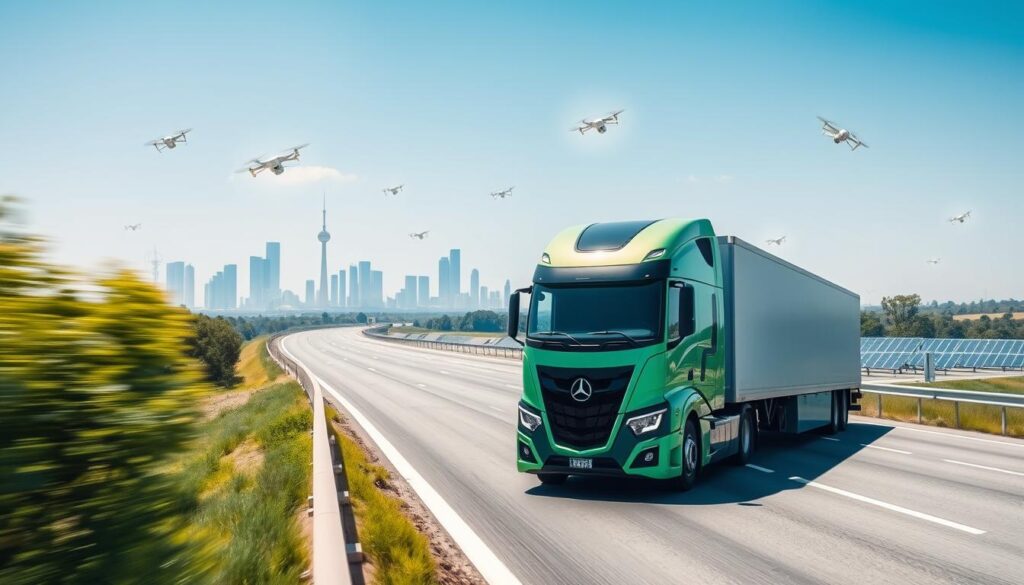
Furthermore, the current models of electric trucks already exhibit notable potential. The Mercedes-Benz eActros 600, Freightliner eCascadia, and the Volvo VNR Electric offer promising single-charge distances. The Tesla Semi stands out with a range of up to 500 miles between charges, corroborated by the North American Council for Freight Efficiency, which recognizes Tesla’s dominance in charging efficiency.
Government incentives are also playing a crucial role. California’s Hybrid and Zero-Emission Truck and Bus Voucher Project provides financial assistance for fleets to acquire electric trucks. Companies like Schneider have successfully capitalized on various incentive programs to incorporate numerous Freightliner eCascadias into their fleet.
Looking ahead, the projected economic advantages are enticing. By 2030, the costs associated with battery electric trucks are expected to be approximately 30% lower compared to those powered by internal combustion engines. Additionally, the operational cost efficiency is set to compel more fleet operators to transition to electric vehicles.
The predicted rise in zero-emission vehicles is reflective of the ambitious future of electric trucks. By 2035, zero-emission vehicles are anticipated to comprise around 70% of all trucks in Europe, North America, and Greater China. This indicates a significant industry shift toward sustainability and operational efficiency in the future of electric trucks.
Conclusion
As the transport industry transformation gains momentum, electric vehicle adoption is emerging as a pivotal factor in creating a sustainable trucking future. Long-haul electric trucks, while initially expensive and faced with infrastructural challenges, promise significant long-term benefits. Battery technology improvements and favorable federal and state incentives are key drivers encouraging this shift.
Fuel cell trucks exhibit substantial operational advantages, presenting operational ranges exceeding 625 miles, which underscores their suitability for extensive routes. These vehicles can be fueled approximately 15 times faster than charging battery electric trucks, reducing time for long-distance drives by up to 35%. Moreover, the lighter weight of a full diesel or hydrogen fuel cell tank compared to heavy batteries translates into greater cargo capacity, enhancing business efficiency.
The environmental and economic benefits of electric vehicles are considerable. Electric trucks reduce greenhouse gas emissions from long-haul heavy trucks, which currently consume 49% of all diesel used by the freight sector, contributing 211 million tonnes of CO2e annually. Despite initial costs, a Class 8 electric truck with a 375-mile range can offer a 13% lower total cost of ownership, with potential savings of $200,000 over 15 years at the current battery pack price of $135 per kWh. As battery prices are projected to decline further by 2030, this trend bodes well for the sustainable trucking future.
In conclusion, although the path to widespread electric vehicle adoption in the trucking sector has its obstacles, the cumulative environmental and economic benefits make for a compelling case. Through strategic planning, improved battery technology, and supportive policies, we can look forward to a cleaner, more efficient future in heavy-duty transport.
FAQ
What are the benefits of long-haul electric trucks?
What challenges do electric semi-trucks face?
How far can current electric trucks travel on a single charge?
Which companies are leading the market for electric semi-trucks?
What federal incentives are available for adopting electric trucks?
How is charging infrastructure for long-haul electric trucks being developed?
What are the long-term economic benefits of adopting electric trucks?
What is the future outlook for long-haul electric trucks?
Why is the trucking sector important in the U.S. economy?
