
Innovations in Electric Truck Batteries: What’s Next for Long-Haul Transportation?

Innovations in electric truck batteries are at the heart of this transformation.
As long-haul freight demands grow fueled by e-commerce expansion and stricter emissions regulations the race to develop more efficient, durable, and sustainable energy storage solutions has intensified.
But what breakthroughs are on the horizon, and how will they redefine the future of logistics?
Consider this: A single diesel-powered semi-truck emits roughly 223,000 pounds of CO₂ annually.
Transitioning to electric fleets could eliminate these emissions, but only if battery technology keeps pace with the demands of cross-country freight.
Are today’s advancements enough to make electric trucks the new standard, or are we still years away from true viability?
The Current State of Electric Truck Batteries
Today’s electric trucks rely primarily on lithium-ion batteries, but limitations persist. Energy density, charging speed, and lifespan remain critical hurdles.
According to a 2024 report by BloombergNEF, battery costs have dropped 12% year-over-year, yet long-haul operators still face range anxiety.
Many fleets require at least 500 miles per charge to match diesel efficiency—a benchmark only a few models currently meet.
Solid-state batteries promise a leap forward. Companies like QuantumScape and Toyota are testing prototypes that could double energy capacity while reducing charging times.
For example, QuantumScape’s solid-state cells reportedly achieve an 80% charge in just 15 minutes, a feat that could eliminate downtime concerns for freight operators.
If commercialized, these innovations in electric truck batteries may finally tip the scales in favor of widespread adoption.
Another emerging contender is lithium-sulfur (Li-S) technology. With a theoretical energy density five times higher than lithium-ion, Li-S batteries could revolutionize freight efficiency.
+Silent but Powerful: The Benefits of Riding an Electric Motorcycle
OXIS Energy, a UK-based firm, has already demonstrated Li-S cells with 400 Wh/kg far surpassing today’s best lithium-ion options. However, cycle life remains a challenge, as sulfur’s tendency to degrade after repeated charges must still be addressed.
Beyond Lithium: The Next Generation of Battery Tech
While lithium dominates, researchers are exploring alternatives that could offer greater sustainability and cost efficiency. Sodium-ion batteries, for instance, provide a cheaper, more abundant material base.
CATL recently announced a sodium-ion battery with 160 Wh/kg—enough for regional hauling. Though not yet suitable for cross-country routes, this technology could soon power last-mile delivery trucks, reducing reliance on scarce lithium reserves.
Graphene-enhanced batteries also show immense promise. Their superior conductivity could slash charging times to under 15 minutes, a game-changer for cross-country logistics.
Imagine a truck stopping for a coffee break and leaving with a fully charged battery this could soon be reality.
Real-world tests by Skeleton Technologies in Germany have demonstrated graphene-based supercapacitors that recharge in 90 seconds, though integrating them into heavy-duty vehicles remains a hurdle.
Perhaps the most radical innovations in electric truck batteries involve structural designs. Tesla’s 4680 cells, for example, integrate battery packs directly into vehicle frames, optimizing weight and space.
This approach could extend range by 20%, making long-haul electric trucks far more competitive.
++Why Electric Trams Are Making a Comeback in Modern Cities
Meanwhile, startup Our Next Energy (ONE) is testing dual-chemistry batteries that combine high-energy-density cells for highway driving with more stable ones for stop-and-go traffic—effectively tailoring power delivery to real-world conditions.
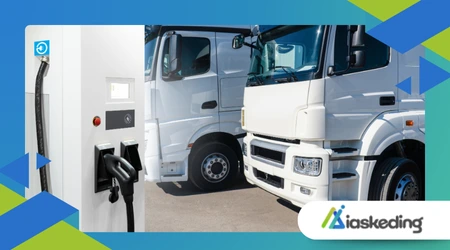
Charging Infrastructure and Energy Recovery Systems
Battery advancements alone won’t suffice charging networks must evolve to support the next generation of electric trucks. Megawatt-level chargers, like those from ABB and Tesla’s Semi program, aim to replenish 400 miles in 30 minutes.
These ultra-fast stations, strategically placed along major freight corridors, could make electric fleets viable nationwide. But deployment remains slow; as of 2025, only 12% of U.S. truck stops offer high-power charging.
Regenerative braking further enhances efficiency. By recapturing kinetic energy, trucks like the Freightliner eCascadia recover up to 8% of expended power, extending operational range.
Think of it as a marathon runner who rehydrates while running rather than stopping for water—every bit of reclaimed energy adds up over thousands of miles.
Wireless charging is another frontier being explored. ElectReon’s dynamic charging system, currently piloted in Sweden, allows trucks to charge while driving via embedded road coils.
Read more: Electric car maintenance: What’s different and what you need to know
While still in early stages, this could one day eliminate charging stops entirely, though infrastructure costs remain prohibitive for now.
Economic and Environmental Impacts
Adopting next-gen batteries isn’t just about performance it’s a financial imperative. The International Energy Agency (IEA) estimates that by 2030, electric trucks could save operators $60,000 annually in fuel costs.
For fleets running hundreds of vehicles, this translates to millions in savings over a decade. Yet upfront costs remain steep, with battery-electric semis still priced 50-70% higher than diesel counterparts.
Sustainability is another driving force. With transport accounting for 29% of U.S. emissions, cleaner batteries are non-negotiable.
Recycling initiatives, like Redwood Materials’ closed-loop system, ensure old batteries don’t become tomorrow’s waste.
Redwood claims it can recover 95% of critical metals from spent batteries, reducing reliance on environmentally damaging mining.
Governments are also stepping in to accelerate adoption. The U.S. Inflation Reduction Act offers up to $40,000 in tax credits per electric truck, while the EU’s upcoming Euro 7 standards will effectively phase out diesel trucks by 2035.
These policies create a powerful incentive for carriers to transition sooner rather than later.
The Human Factor: Training and Workforce Adaptation
Technological progress means little without a workforce ready to implement it. Diesel mechanics must retrain to service high-voltage battery systems, while logistics planners need new tools to optimize routes around charging stops.
Companies like Volvo Trucks are already partnering with vocational schools to develop specialized EV technician programs.
Driver acceptance is another hurdle. Many long-haul operators remain skeptical of electric trucks’ capabilities, fearing breakdowns in remote areas.
Addressing these concerns requires not just better batteries, but real-world proof of reliability. Pilot programs, like PepsiCo’s deployment of Tesla Semis for Frito-Lay deliveries, provide valuable data to build industry confidence.
Table: Key Battery Technologies Comparison (2025 Data)
| Technology | Energy Density (Wh/kg) | Charging Time | Potential Range |
|---|---|---|---|
| Lithium-Ion | 250-300 | 45-90 min | 300-400 miles |
| Solid-State | 400-500 | 20-30 min | 600-700 miles |
| Lithium-Sulfur | 500-600 | 30-45 min | 800+ miles |
| Sodium-Ion | 120-160 | 60+ min | 200-250 miles |
Conclusion: The Road Ahead
The future of long-haul transportation hinges on innovations in electric truck batteries.
From solid-state breakthroughs to smarter energy recovery, the industry is accelerating toward a cleaner, more efficient era. Yet challenges remain—cost, infrastructure, and material scarcity must be addressed.
Will the next five years bring the tipping point where electric trucks dominate highways? The signs point to yes, but only if battery tech continues its rapid evolution.
One thing is certain: the companies investing in these advancements today will lead the freight revolution of tomorrow.
Frequently Asked Questions
How long do electric truck batteries last?
Current lithium-ion batteries in heavy-duty trucks typically last 500,000 to 1 million miles before needing replacement, with gradual capacity loss over time.
Can electric trucks handle extreme weather?
Cold weather can reduce range by up to 30%, but thermal management systems in newer models mitigate this. Some fleets in Nordic countries already operate successfully year-round.
Are hydrogen fuel cells a better option?
While hydrogen offers fast refueling, its inefficiency (only 30-40% of energy reaches the wheels vs. 75% for batteries) makes it less economical for most freight applications.
