
Power Electronics Cooling Boosting Electric Car Efficiency
Power Electronics Cooling Boosting electric vehicle range stands as one of the most vital technical breakthroughs in modern automotive engineering today.
Automotive manufacturers invest heavily in advanced thermal management systems to ensure traction inverters, onboard chargers, and DC-DC converters operate within ideal temperature boundaries continuously.
Optimizing heat removal directly reduces parasitic energy losses within high-voltage circuits, allowing drivers to extract maximum mileage from every single kilowatt-hour stored in the battery.
What is power electronics cooling and why does it matter?
Power electronics in electric vehicles serve as the essential electrical bridge between energy stored in the battery pack and power delivered to the propulsion motors.
Traction inverters convert direct current into alternating current, generating substantial internal heat during rapid acceleration maneuvers and intensive regenerative braking cycles.
Without active cooling mechanisms operating at peak efficiency, internal semiconductor junctions experience severe thermal stress that degrades power conversion efficiency and accelerates material fatigue.
Advanced thermal architectures continuously draw heat away from silicon and silicon carbide power modules, maintaining uniform energy delivery across challenging real-world driving conditions.
Proper thermal regulation preserves electronic component integrity over hundreds of thousands of miles, ensuring long-term vehicle reliability while preventing catastrophic component failure.
How does thermal management improve overall driving range?
Excess heat in high-power semiconductor switches creates electrical resistance, converting valuable battery power into wasted thermal energy instead of useful mechanical momentum.
Power Electronics Cooling Boosting drivetrain efficiency prevents voltage drops across the inverter switches, preserving peak conversion rates under sustained high-speed highway cruising.
Targeted fluid flow patterns over direct-bonded copper substrates eliminate localized hotspots, allowing the powertrain controller to run higher continuous currents without triggering thermal throttling.
| Cooling Technology | Thermal Transfer Medium | Typical Application | Key Performance Benefit |
| Indirect Liquid Cooling | Water-Ethylene Glycol | Main Traction Inverters | High reliability and proven automotive durability |
| Direct Pin-Fin Cold Plates | Micro-channel Coolant | Silicon Carbide Modules | Minimal thermal resistance and compact packaging |
| Direct Liquid Immersion | Dielectric Synthetic Fluids | Next-Gen High-Density Units | Uniform temperature control and zero localized hotspots |
| Phase-Change Heat Pipes | Vapor-Liquid Sealed Cycle | Auxiliary DC-DC Converters | Passive heat spreading with zero parasitic pumping loss |
Integrating waste heat recovery systems further optimizes real-world vehicle range by capturing inverter thermal energy to warm the passenger cabin during cold winter operations.
Engineers can analyze detailed testing procedures and thermal efficiency standards established through the official U.S. Department of Energy Vehicle Technologies Office research programs.
Which cooling technologies deliver the highest efficiency gains?
Direct-cooled pin-fin heat sinks integrated directly beneath power semiconductor packages represent the current gold standard for mass-market electric vehicle production worldwide.
Fluid channels machined into aluminum cold plates sit in direct contact with module baseplates, removing heat immediately at the microscopic point of origin.
Dual-sided cooling configurations sandwich power modules between two liquid cold plates, doubling heat dissipation capacity while reducing overall component packaging volume significantly.
Transitioning toward wide-bandgap semiconductors like Silicon Carbide enables higher operating temperatures, requiring precise liquid loop control to maximize fast-switching benefits fully.
Learn more: Electric Car Battery Cooling Plate Systems Growth
Phase-change thermal management systems represent another emerging pathway, utilizing latent heat absorption to neutralize extreme temperature spikes during aggressive performance driving maneuvers.
How does fast charging depend on advanced inverter cooling?
Ultra-fast charging stations push hundreds of kilowatts through onboard power electronics, driving thermal loads to extreme levels within seconds of connection.
Maintaining precise temperature thresholds prevents thermal runaway risks and protects sensitive gate drivers from experiencing severe dielectric breakdown over repetitive charge cycles.
Read more: Electric Motorcycle Cooling Limits in Hot Climates
Effective Power Electronics Cooling Boosting charging throughput ensures the power conversion hardware maintains maximum energy transfer rates throughout the entire charging curve.
Active cooling loops balance thermal distribution across the inverter, onboard charger, and DC-DC converter, preventing localized heat build-up during intensive fast-charging sessions.
Intelligent thermal preconditioning aligns the temperature of both the power electronics and the battery pack prior to arriving at high-power DC fast-charging plazas.
What role do Wide-Bandgap semiconductors play in thermal design?
Silicon Carbide and Gallium Nitride devices operate at higher switching frequencies and elevated junction temperatures compared to traditional silicon-based insulated-gate bipolar transistors.
Higher frequency operation reduces passive component sizes like inductors and capacitors, allowing engineers to build significantly lighter and more compact power electronics enclosures.
Lighter overall component weight directly lowers total vehicle mass, yielding measurable improvements in energy consumption per mile driven across all driving conditions.
learn more: High Torque Axles Advancing Electric Truck Performance
Despite superior material properties, smaller semiconductor die sizes concentrate heat into tiny surface areas, requiring advanced micro-channel liquid cooling designs for stability.
Comprehensive insights regarding international thermal testing methodologies and technical vehicle benchmarks can be reviewed via the National Renewable Energy Laboratory Transport Research portal.
When should automotive engineers upgrade thermal architecture designs?
Upgrading from basic air cooling or single-sided cold plates becomes mandatory when vehicle architectures transition from 400-volt to 800-volt high-power battery systems.
Higher voltage systems enable faster charging times and elevated continuous power output, demanding heat dissipation systems capable of managing severe, instantaneous thermal spikes.
Integrating the power electronics cooling loop into a unified vehicle thermal management network maximizes overall heat pump coefficient of performance during all seasons.
Streamlined fluid routing reduces coolant pump electrical power consumption, preserving vital electrical energy for the traction motors to extend real-world driving distance.
Co-designing power electronics hardware alongside thermal cooling infrastructure ensures ideal fluid dynamics, reduced pressure drops, and maximum thermal conductivity across the entire power module.
How does advanced coolant formulation impact heat extraction?
The chemical formulation of circulating coolants plays a pivotal role in determining the heat absorption rate and overall longevity of thermal management loops.
Traditional water-ethylene glycol mixtures offer excellent heat capacity and anti-freeze protection, but newer dielectric fluids enable direct contact with electrical components without short-circuit risks.
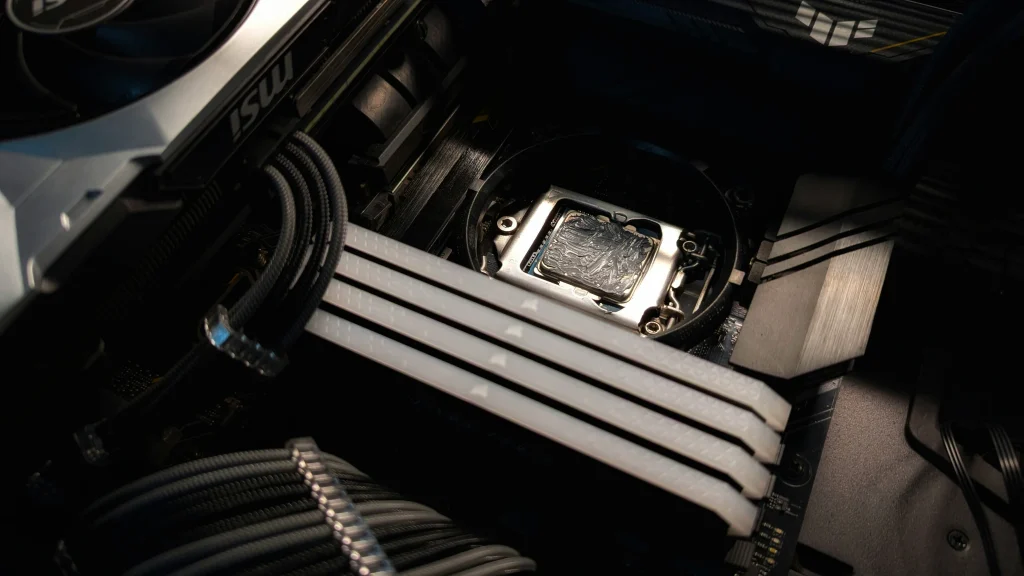
Engineered fluids with low viscosity reduce internal pump resistance, minimizing the auxiliary energy required to circulate coolant through intricate cold plate channels.
Inhibitors added to coolant formulations prevent internal corrosion and cavitation, ensuring that copper and aluminum cold plates retain optimal thermal transfer properties over decades.
Frequently Asked Questions (FAQ)
How does power electronics cooling affect real-world electric car range?
Effective thermal management reduces internal electrical resistance and prevents thermal throttling, allowing the traction inverter to convert up to 98% of battery energy into motion.
Is liquid cooling better than air cooling for vehicle power modules?
Liquid cooling offers vastly superior thermal conductivity, handling heavy thermal loads in compact spaces where air cooling would prove completely inadequate for modern electric vehicles.
What liquid is commonly used in electric vehicle cooling systems?
Most current electric vehicles utilize a mixture of water and ethylene glycol, though next-generation designs increasingly explore synthetic dielectric fluids for direct immersion cooling setups.
